Zeus’s Divine Spark
A Man in FullZeus’s Divine Spark is the inward faculty of reason and choice that Epictetus presents as belonging to every human being. For Conrad Hensley, reading about it in prison makes it more than a consoling idea: it becomes a standard by which to judge fear, courage, and the meaning of manhood. Its force lies in a sharp contrast. A person may be exposed to imprisonment and physical danger, but those external conditions cannot by themselves take away the will to choose how to respond.
Definition and Stoic Teaching
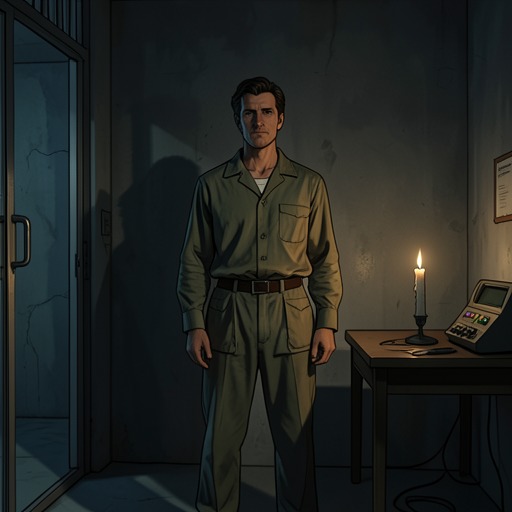
Conrad encounters the idea in The Stoics, reading at a bolted metal table on a bolted metal stool while trying to shut out the prison pod around him. The pages are described as forlorn, but the teaching they carry is insistently clear. Epictetus says that all human beings are children of Zeus, given a spark of divine fire. That spark grants the capacity to reason, to act or refrain from acting, and to pursue or avoid. The purpose of those choices is moral: “To get what is good,” and “to avoid what is evil.”
The distinction separates what depends on a person’s will from what does not. Money, possessions, fame, and political power cannot be secured by will alone; neither can imprisonment or physical danger simply be willed away. The spark is therefore not a promise that a person can control events. It names the faculty that remains available when events are beyond control. In Conrad’s reading, inward freedom is not an escape from hardship but the possibility of making a moral choice within it.
Epictetus’s example of Hercules gives this teaching an active form. Without lions, hydras, stags, boars, and unjust or brutal people to confront, Hercules would have had no occasion to use his strength, endurance, and noble heart. Peril becomes a trial in which character can be exercised. Conrad nods as he reads, taking the lesson into a life where danger is not an abstract example but a condition of confinement.
The Idea Under Pressure
The teaching becomes difficult when Conrad’s fear, anger, and guilt gather around the prospect of what may happen in the pod. He wonders whether the response required of him is simply to avert his eyes and do nothing, as he believes the others do. That doubt threatens the whole framework he has found in Epictetus: if the teaching cannot guide him through a real test, he fears that he has nothing left to draw upon, not even the spark on which he has based his remaining hope.
He answers the doubt by recognizing it as a test of his own faith. Recalling Epictetus’s challenge to greet trial as an opportunity to bring honor through what befalls, Conrad sees that he has begun to tremble and mourn before anything has happened. His shame turns on a new understanding of the body. Epictetus calls a person “a soul carrying a corpse and a quart of blood”; Conrad applies the image to his own fear of bodily harm and concludes that the living part of him is the soul, identified with Zeus’s spark. The passage does not remove his vulnerability. It changes the question from whether he can avoid danger to whether fear will determine his response.
Confronting Rotto
Conrad’s reading becomes a physical practice. Still sitting upright, he places both hands, palms down, on the pages of The Stoics and closes his eyes, aware that the pod is watching. He deliberately rejects what he understands as the pod’s code of false manliness. Instead of seeking courage from the approval of other prisoners, he tries to quiet their voices and the room’s television noise, emptying his attention of sensation and turning inward toward the divine.
When he opens his eyes, Rotto is approaching. Conrad wants to look away, but finds himself staring at the larger man. The sudden encounter gives the earlier lesson its concrete test: the divine spark is invoked not as physical protection but as a ground for facing what is coming. Conrad looks for Five-O, his last earthly comrade, while knowing that he does not expect Five-O to intervene. About thirty feet away, Five-O stands with his Latino companions, watching along with the rest of the pod. The scene sets the solitary character of Conrad’s choice against a crowd waiting for the confrontation. His inner discipline cannot make the onlookers help him or make Rotto harmless; it gives him a way to understand himself amid their attention.
Family and Transmission
After the violence, Conrad lies with his heart racing and tries to picture Carl, Christy, and Jill. His effort falters: his children become tiny ghosts, and he cannot bring Jill’s face into focus. Instead, he sees an angry brow and her body as flesh, unable to recover the feeling of love he is reaching for. The difficulty matters because it prevents the spark from serving as an easy assurance that his family remains vividly present to him. Prison has narrowed his immediate world, and even memory feels strained.
Conrad nevertheless reaches a different recognition. Through his flesh, he has transmitted Zeus’s spark to Carl and Christy. The body that Epictetus’s formulation reduces to a corpse and a quart of blood is also, in Conrad’s understanding, the means by which the next generation received the inner capacity that matters most. This connects Stoic inwardness to family responsibility: the spark is not only something to preserve in oneself, but something carried forward through one’s children.
He cannot yet picture Carl clearly, but he thinks of the future in which his son will become a man and need someone to tell him what a man is. That thought gives the concept its lasting human stakes. Against the pod’s spectacle of masculine force and humiliation, Conrad’s understanding of manhood rests on moral agency, endurance, and the inheritance of character. The spark does not resolve his fear or restore his family to him in the moment; it gives him a language for remaining answerable to them.